Building a community that enjoys a rich quality of life for all ages, brings a more equitable society, and a harmonious and responsible relationship with the natural world.
It’s been a busy fall and it’s hard to believe winter is around the corner. Maybe we’ll still get in a nice hike or bike ride to enjoy the fall weather before it snows.
Upcoming Events
In an attempt to not fill your inbox with unwanted emails, we don’t send out reminders throughout the month. If you would like to receive email reminders before each event, email tcfamilycoop@gmail.com and say “sign me up for reminders.” You can specify if you only want reminders about online events and not in-person events.
Virtual Info Session and Tour - Sunday, November 8 2:00-3:30pm
Curious about life in our community? Join us for this online event. See below for more details. Use this link to RSVP.
November Potluck - Sunday, November 15 5:00-7:00pm
Join us for good food and good company! We’ll provide a vegetarian main dish, drinks, and dishes. Bring your kids, bring your friends, we can’t wait to see you! Use this link to RSVP.
Check our website or facebook page for events in the coming months. If you can't make it to these events and you want to connect, email tcfamilycoop@gmail.com. We’d be happy to connect in person or online.
Out in the World
Over the last couple months, we’ve had several opportunities to represent TCFC out in the world, meet neighbors, experience other communities, and network.
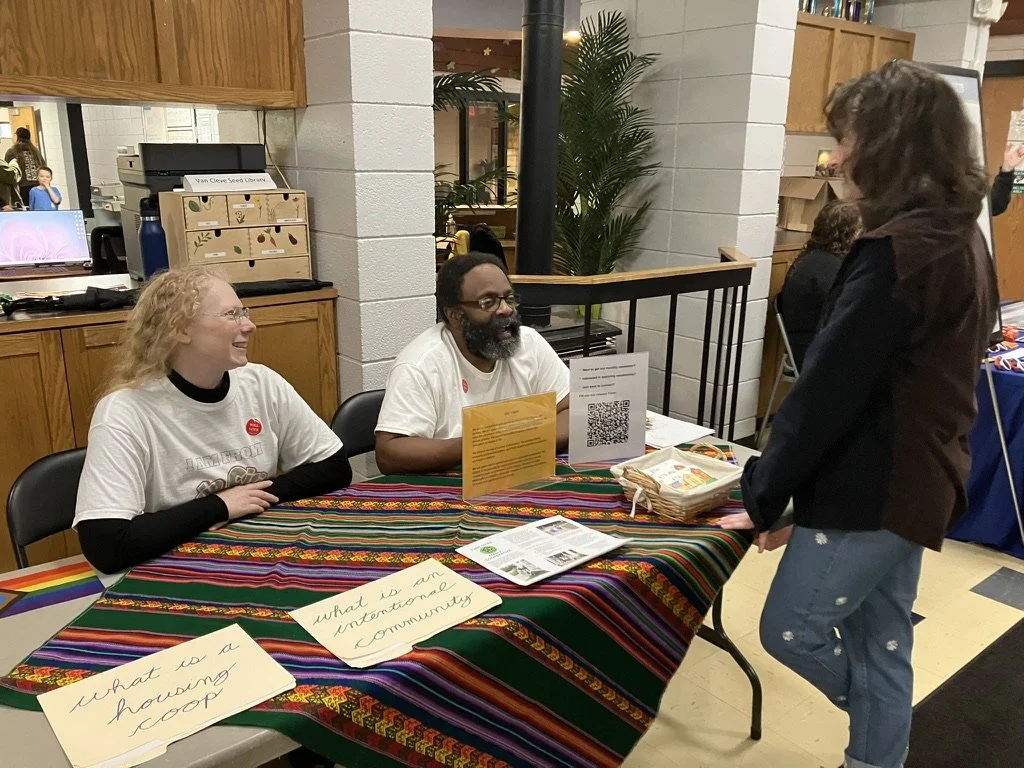
We finished up the summer by participating in two neighborhood events. Although it was a rainy day, Malik and I talked to many folks who stopped by our table at the Explore Como event. A few weeks later we led a workshop at the Sustainable Living Festival and shared a table with CohousingMN. Our workshop, Sustainability’s Coming to Dinner, focused on how sustainability is woven throughout our community’s meals together and all our practices around food.
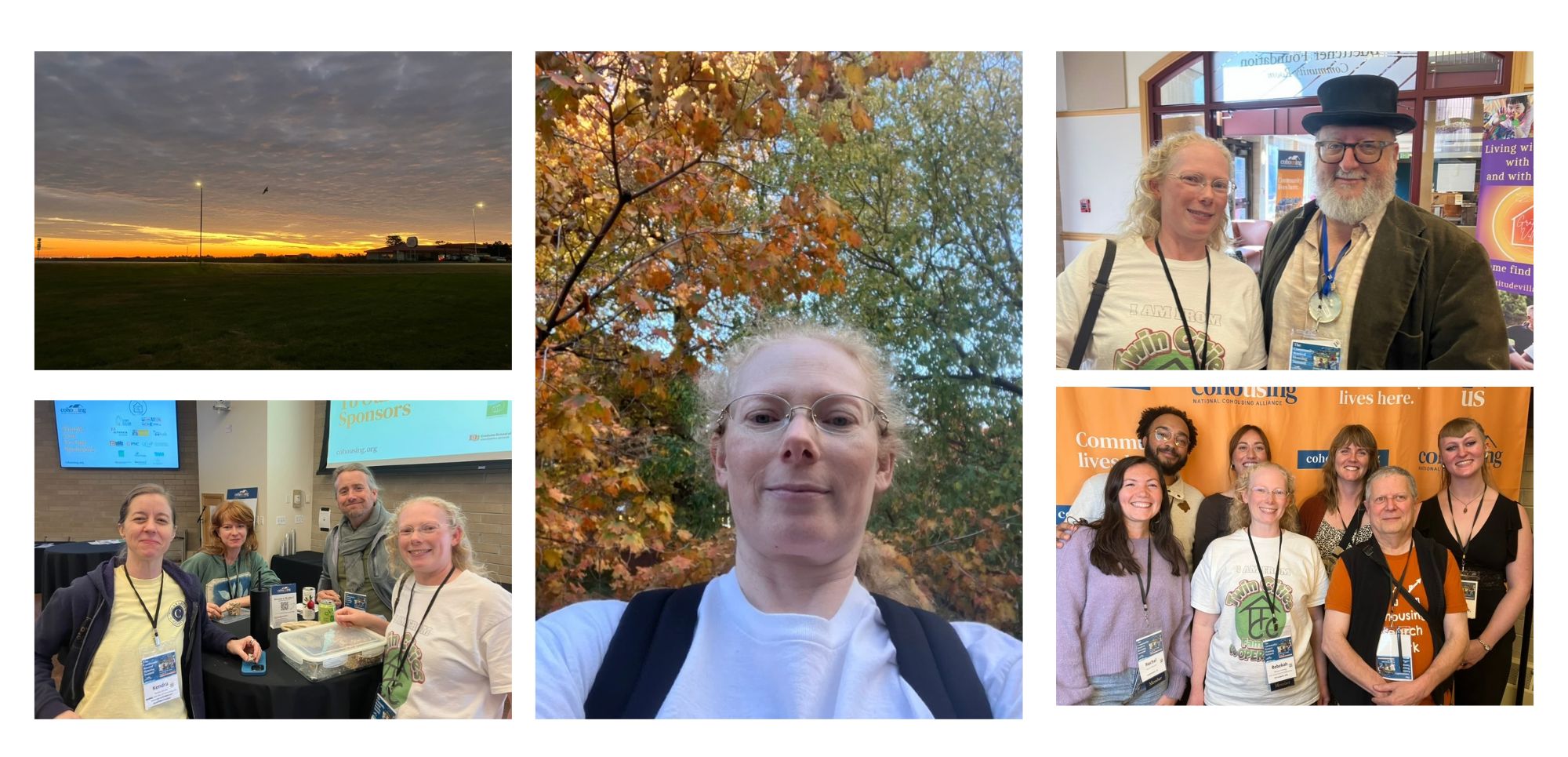
At the end of October, I attended The Community-Rooted Housing Summit in Denver, Colorado. Joined by a couple other folks from Minneapolis, I took a road trip through South Dakota to get there. By chance, another woman in my hostel room was also attending the summit so we became travel buddies. We both went on a tour of several communities ranging from 7 friends buying a duplex and turning it into 4 apartments to a beautiful historic mansion turned into affordable housing for 20 people. It was interesting to hear how different groups have come together and see how they turned properties into communities. Each community had their own financial structure and income streams, their own labor agreements, membership process, ways of sharing life together, and reasons for existing. Between stops, I connected with the other people on the tour, heard about communities they live in or what they are looking for, or how they support communities, and I shared about Twin Cities Family Cooperative. It was really fun to meet so many people.
The opening night talk examined the rise of the single family house and how it has been used to separate people and uphold patriarchy. It was a fascinating talk. The following day of workshops were fun and educational and there was lots more time to connect with people. I attended workshops on Navigating Conflict in Community, Belonging by Design: Neurodiverse Community, Making Shared Life Work, and Designing for Connection. Maybe I’ll write about those in upcoming newsletters!
Written by Beka Herzog
Online Info Session and Tour
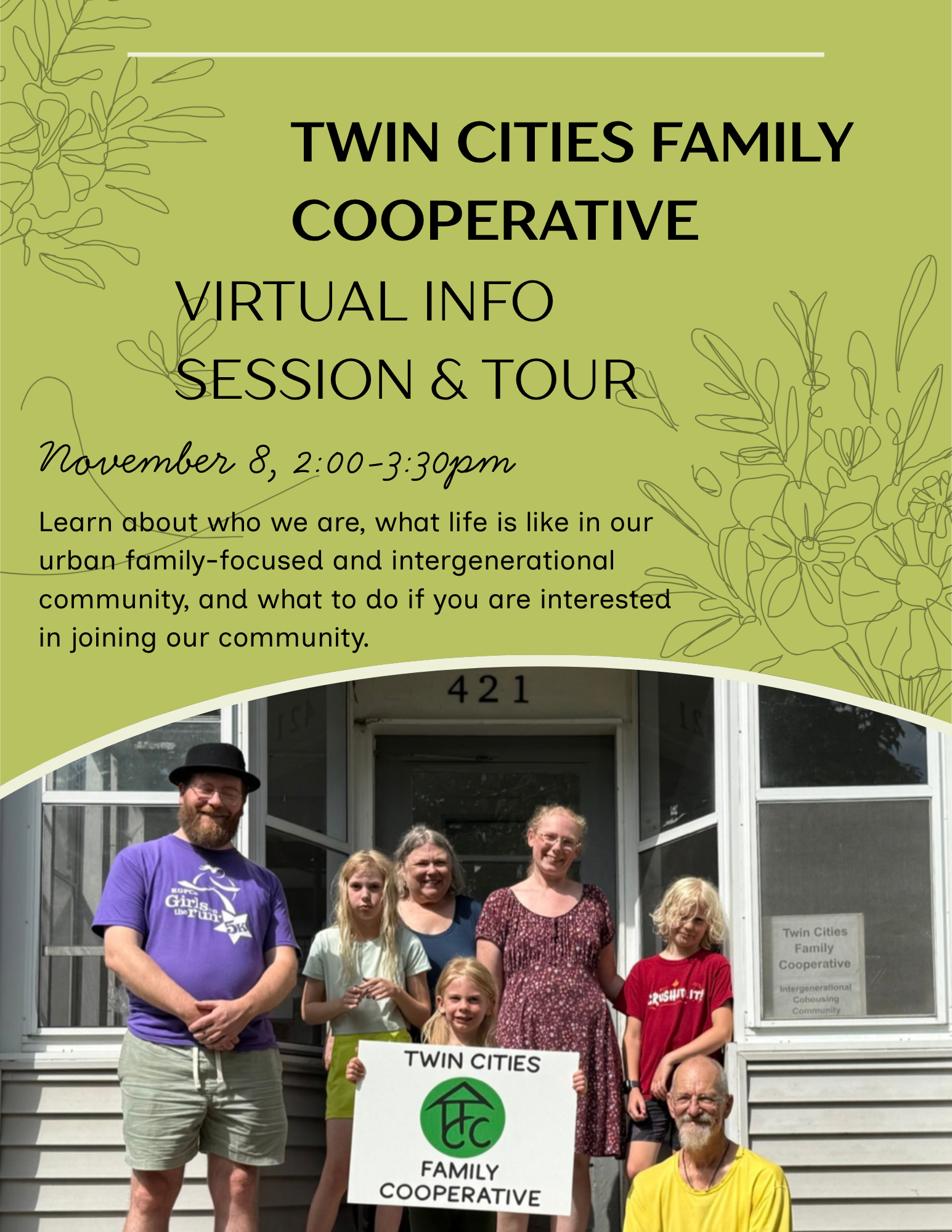
Curious about life in our community? Join us for this online event, packed with information. We'll take you on a virtual tour of our current community property, a 7-unit apartment building, and share our future plans to double the size of our building. We'll talk about who we are, what life is like in our urban family-focused and intergenerational community, and what to do if you are interested in joining our community. We'll also have plenty of time for questions. link to RSVP.
Reaching for Openness in a Competitive World
“Capitalism is a structure that encourages individual finances and embeds commodification and transaction into our relationships with each other and the world around us. This fosters and reinforces a culture of hyper-individualism, privacy, competition, objectification, and entitlement. It creates an experience of separation, isolation, loneliness, and fear, and normalizes inequality, oppression, exploitation, and violence.” (Sky Blue: Challenges and Strategies for Anti-capitalist Community)
Let’s think about the privacy aspect. It is generally considered poor form to talk about finances. One company I worked for would fire someone if they talked to a coworker about what their salary was. It’s countercultural to talk openly about our income, our debts, and how much we spend on things, but at TCFC we strive to shift that. It’s important for us to share openly about our income, assets, and debts because our community finances come from personal contributions from each household and our community has decided that equity is important in these decisions. Our monthly operating dues are based on 30% of one’s gross income and personal loans based on a household’s assets gives us capital for our property.
It has been a process of growth to talk more openly with each other about finances. We realized that some of us were basing one's monthly contribution on gross income while others were basing in on one's net income. It can still be challenging to talk about because of the cultural messages of worth that influence us and the idea that our security is based on personally building up wealth, but it can bring us closer together when we trust each other.
Another area where competitiveness and shame often live is in the area of labor - how much labor each person is putting in. There is a cultural norm that status is tied to how much work one is doing, and often there is a reluctance to talk about this openly without feeling competitive and fearing the experience of shame if one “doesn’t measure up.” At TCFC we have tried both complete transparency as well as to let one’s labor contributions be private information. As we find labor contributions vary and there is work that is not getting done, we are finding it important to talk about what one is doing more openly and not attach shame to having differences in contribution. We want to be free to talk matter-of-factly about what the needs are. It’s about getting the work done, not about measuring one’s worth according to how much one contributes. We have a baseline amount expected of each person, and need to be able to talk without shame if someone needs to pick up more (or let go of doing too much, especially if it leads to feeling resentful of others). Again, there is some learning and discomfort at first but we see it as part of living out our values to approach labor in this way.
Written by Nancie Hamlett
Cooperative Culture
We hope you’ve enjoyed Nancie’s monthly reflections on the Cooperative Culture keys in Yana Ludwig’s and Karen Gimnig’s book “Cooperative Culture Handbook: A Social Change Manual to Dismantle Toxic Culture and Build Community.” You can purchase the book at ic.org’s online bookstore.
Our Vision
We are an intergenerational community of individuals, couples, and families. We are queer-affirming, gender-inclusive, and multicultural. We value the spectrums of the human experience and each individual’s diverse abilities. We support each other in raising children and throughout all stages of life.
We strive to live out of a place of abundance. We develop internal economic policies that actively push back against capitalist expectations and ways of relating.
We are committed to nonviolence and environmental sustainability. We believe in the potential for radical transformation of society and see communal living as an element of that change. We strive to make meaningful contributions to society, engaged in dismantling the systems of racism and oppression in our society.
If you would like to learn more about Twin Cities Family Cooperative, please watch a virtual tour of our community, visit our website and facebook page, attend our events (online and in-person), or fill out our Interest Form to connect. All past newsletters can be found here. If you would like to be removed from our email list, please email us and let us know.