Newsletter September 2026
Building a community that enjoys a rich quality of life for all ages, brings a more equitable society, and a harmonious and responsible relationship with the natural world.
Last summer was our first summer in our community building and we spent much of it moving in and working on the building. While there are still always things on our to-do list, this summer we got to enjoy a little more relaxed pace (if such a thing is possible with 4 children). Now we’re in a whirlwind of going to the State Fair and the Renaissance Festival and getting ready for the kids to go back to school.
Upcoming Events
In an attempt to not fill your inbox with unwanted emails, we don’t send out reminders throughout the month. If you would like to receive email reminders before each event, email tcfamilycoop@gmail.com and say “sign me up for reminders.” You can specify if you only want reminders about online events and not in-person events.
September Online Drop-In - Wednesday, September 16 12:00-12:45pm
A time to drop in and ask a question or just say hi. Life can be busy but this is an easy, informal opportunity to connect. No need to register ahead of time, just put this link on your calendar and show up.
2026 Free Sale - September 19-20
Sat Sept 19th 9AM-8PM
Sun Sept 20th 9AM-4P
More info and ways to participate here
September Potluck - Saturday, September 26 5:00-7:00pm
Join us for good food and good company! We’ll provide a vegetarian main dish, drinks, and dishes. Bring your kids, bring your friends, we can’t wait to see you! Use this link to RSVP.
Blending Cohousing and Cooperative for Affordability (hybrid event) - Wednesday, October 14 6:00-7:30pm
(see below for details)
October Potluck (Halloween Themed) - Sunday, October 18 5:00-7:00pm
Check our website or facebook page for events in the coming months. If you can't make it to these events and you want to connect, email tcfamilycoop@gmail.com. We’d be happy to connect in person or online.
Our Favorite Things About Summer
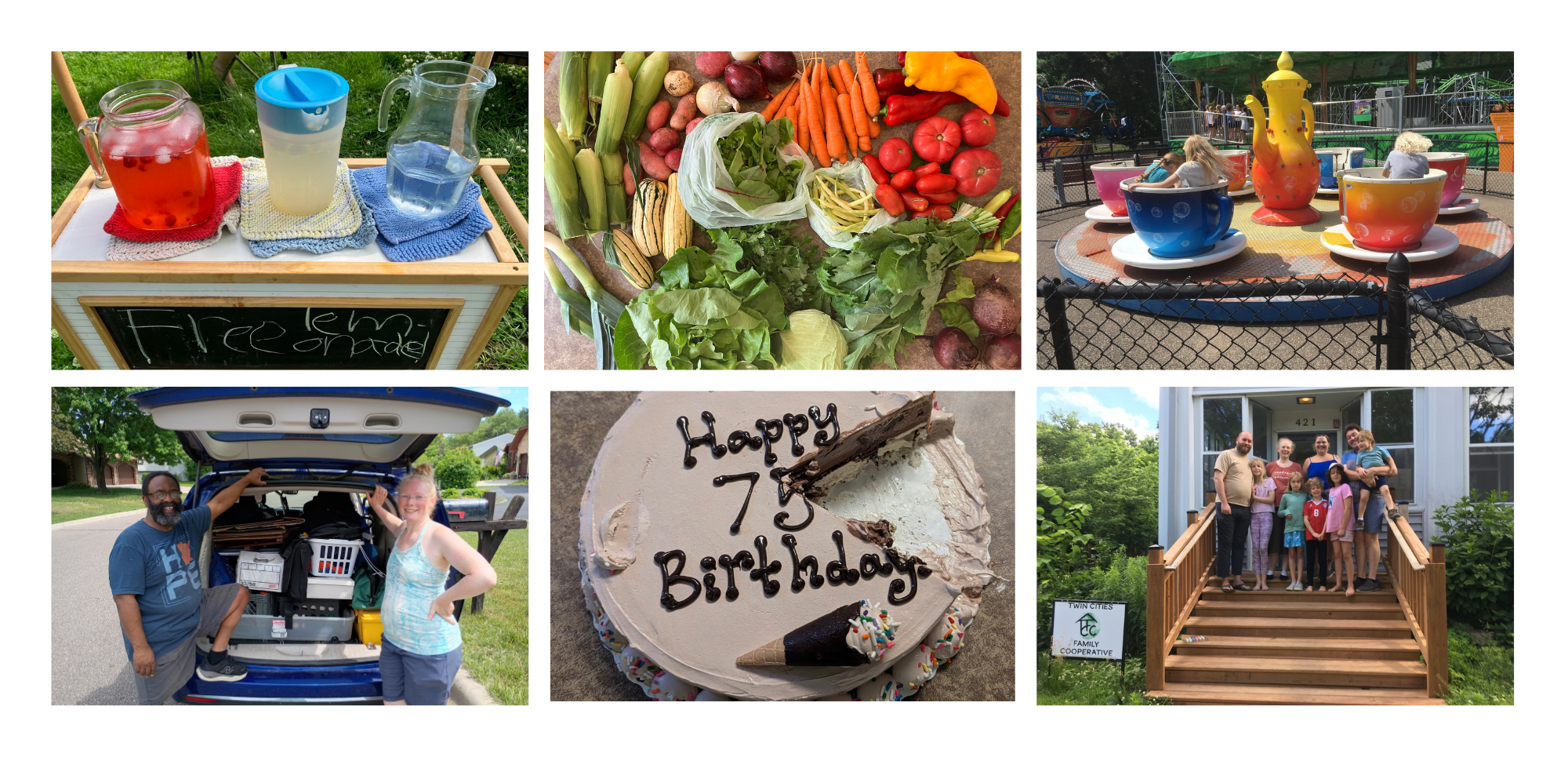
Lemonade stand with free lemonade for everyone
Trips to Como Town, the zoo, museums, and the library with the kids
Visits from friends, old and new
CSA veggies from Community Homestead
Jumping on the trampoline
Birthday parties
Malik moving in
An Interview with Children in Our Community
Beka interviewed the 4 children (ages 6, 10, 11, and 12) at Twin Cities Family Cooperative.
What’s it like to be a kid living in community?
A - It’s nice to actually have friends to come home to
L - Awesome, it’s really fun and nice to have friends to come home to
H - fun because of the other kids and maybe more kids later
E - I like jumping (on the trampoline) when there’s friends to jump with
How is living here different from living in a house or apartment with just your family?
A - Since I’m an only child, it’s different but much more fun
L - There are lots more people to talk to and spend time with
H - There’s more people
E - There’s more people to hang out with
What do you do with other children?
A - I like to play with them and jump on the trampoline and make up new games and do other stuff even if it’s just sitting in a room
L - I jump on the trampoline and talk about stuff. I also like when we give out free lemonade at our lemonade stand.
H - We play minecraft and play outside and sometimes listen to music
E - I jump and play with neighbor kids
What is it like to live with other adults?
A - I get to try new foods and see what other adults cook. I like to hear their stories and learn about them and other people’s culture and religion and stuff
L - I like to spend time with people. It’s nice to have random people to talk to.
H - I’m not around them very much
E - I like to play games with them
What do you like to do as a community?
A - When other people share stories
L - I like it when we eat supper together
H - I like when we have parties
E - I liked the popsicle party
What do you think about community meetings?
A - Most the time the kids aren’t usually there
L - I think they’re interesting and kind of fun
H - They’re boring
E - Fun, I leave after the part for the kids
How do you help the community and people in the community?
A - I’m a friend and I’m entertainment. I harvest raspberries and pull weeds.
L - With my positive attitude. I help by bringing positivity. I like to help by making art for the community and cooking dinner sometimes.
H - I help cook, wash dishes, clean the kitchen, wash windows, clean the radiators, do community laundry, pull weeds, pick raspberries with the other kids, and bring stuff to the little free library.
E - I help people work and plant things and fix things and build things. It was fun making the bird house.
What are meals like?
A - Sometimes they’re good and sometimes they’re not so good but it’s good to see what everyone else makes and what’s important to them or their culture, it’s fun to eat together. The question of the day is fun.
L - I think the meals are sometimes yummy and sometimes I don’t like them but I really like eating together
H - They’re yummy … usually
E - Yummy, yummy, yummy, yummy
Where do you spend your time?
A - With my friends
L - In the common spaces, with friends
H - With friends, a lot of different places like outside, the trampoline, and the library
E - With everyone
What’s your favorite thing to do outside?
A - Jump on the trampoline
L - Jump and go to the park and the pool and have a lemonade stand
H - Jump and go to the park and the pool
E - Jump and ride my bike
If you could change something about our community, what would it be?
A - I wouldn't change anything because I love the community (hugs)
L - I would add lots more people. And another building with a roof pool.
H - I would add a pool on the roof
E - I would add more silly
What’s the best thing about living in community?
A - My friends
L - My friends
H - The other kids, my friends
E - My friends
Blending Cohousing and Cooperative for Affordability
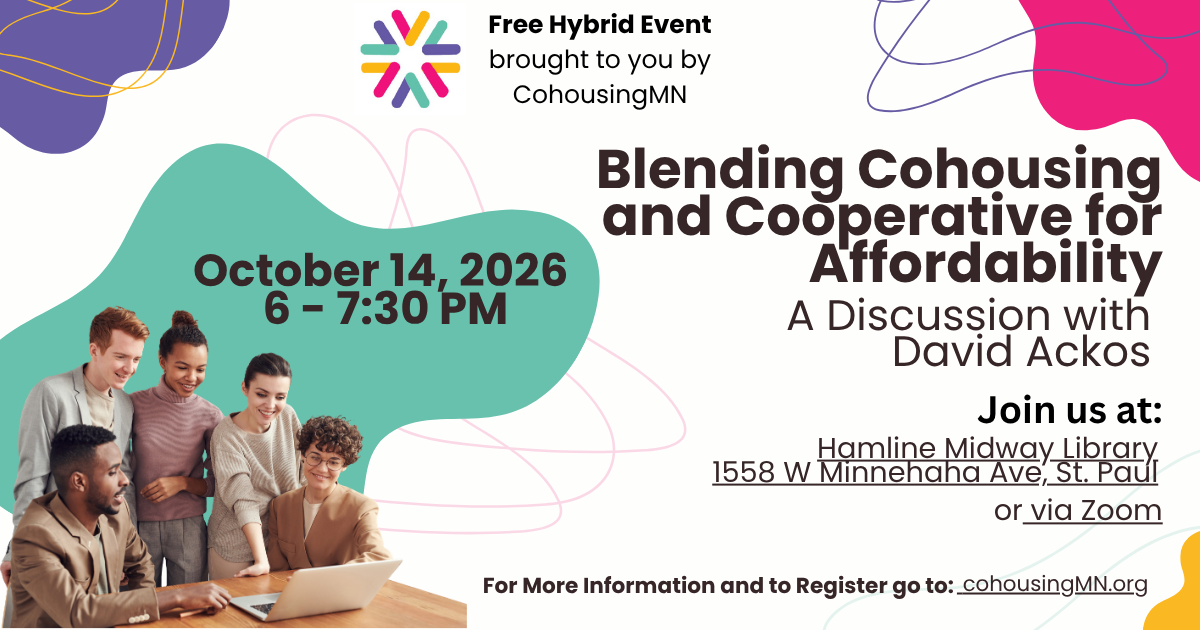
FREE: Wednesday, Oct. 14, 6:00-7:30 PM (virtual and in person)
View on your own or with others at the Hamline Midway Library, 1558 W Minnehaha Ave, St. Paul.
Housing advocate David Ackos (they/them) recently saw and studied something in Germany that was striking: lovely intentional communities average people can afford. Ackos thinks this co-op-based model has the potential to help transform how human needs are met in the US. They also see ways to apply the model to housing and cohousing, which remain stubbornly expensive.
“I look forward to sharing some of my research from Berlin and Leipzig on ways people manage combined cohousing and co-op projects and how those ideas fit together well,” said David. “I’ll share pictures of Spreefeld and Ourhouse, as well as the SoWo (Solidarity Housing) cooperative.”
David’s research was completed while working on a Master’s degree in Urban Management at Technische Universitat Berlin. Their thesis was titled “Transforming Housing Systems Via Shared Ownership: Advancing decommodified cooperative housing in Minneapolis and St. Paul, Minnesota”. As a researcher, organizer, writer and teacher, David is keen on helping change systems to make people’s lives better.
David is currently working on two tenant-to-shared ownership conversions, and founding a multi-generational, mixed-income, and mixed-ethnicity cooperative with friends and loved ones in the Twin Cities. They will share some about these projects.
This event is sponsored by CohousingMN, a charitable nonprofit organization, and is made possible with donations from our supporters.
Cooperative Culture: “Skills Used to Empower”
This month Nancie reflects on “Skills Used to Empower,” one of the Cooperative Culture keys in Yana Ludwig’s and Karen Gimnig’s book “Cooperative Culture Handbook: A Social Change Manual to Dismantle Toxic Culture and Build Community.”
The authors talk about the extremes between corporate culture’s focus on using one’s skills “to gain power, and wealth, to ‘climb the corporate ladder’ which often comes as the expense of keeping others down, while at the other end of the spectrum “no individual credit is given and skills and knowledge are treated as community property.’” In the latter situation “there is an expectation that all skills should be shared indiscriminately, which is really just a different type of extraction of labor.”
In a community where an individual’s expertise is harnessed with teaching others the skill, some of the burden can be eased over time as others who learn some of that skill can pick up doing some of the work and “no one person will always be the expert.”
At TCFC we have not been intentional about teaching each other, sometimes we’re just trying to get the work done when there is a lot of work in founding an intentional community and fixing a building that has been long neglected. But we have recently formed work teams where those with similar interest and expertise can focus on a particular area. Those individuals can share their expertise with others on the team and learn from each other.
The children are often learning skills from the adults. One fun example happened when an older Explorer with good “fix it” skills would sometimes teach his “5-year-old shadow” how to do something. It surprises me when I need a tool that the now 6-year-old knows what it is and can go and get it for me. Or when talking about something that needs to be fixed they say “I know how to do that!” And while they still may need supervision working on a project, they are learning a skill and developing self-confidence. Another good example is how all of the children are encouraged to participate in cooking and can now cook simple things independently. So I guess our strength is in teaching the children more so than teaching each other.
Our Vision
We are an intergenerational community of individuals, couples, and families. We are queer-affirming, gender-inclusive, and multicultural. We value the spectrums of the human experience and each individual’s diverse abilities. We support each other in raising children and throughout all stages of life.
We strive to live out of a place of abundance. We develop internal economic policies that actively push back against capitalist expectations and ways of relating.
We are committed to nonviolence and environmental sustainability. We believe in the potential for radical transformation of society and see communal living as an element of that change. We strive to make meaningful contributions to society, engaged in dismantling the systems of racism and oppression in our society.
If you would like to learn more about Twin Cities Family Cooperative, please watch a virtual tour of our community, visit our website and facebook page, attend our events (online and in-person), or fill out our Interest Form to connect. All past newsletters can be found here. If you would like to be removed from our email list, please email us and let us know.